
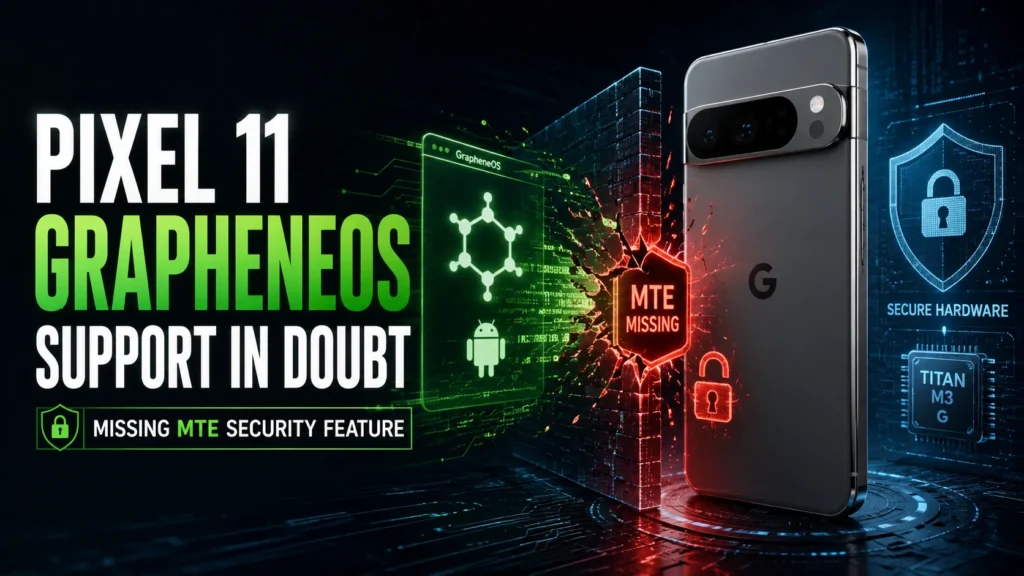
Google’s Pixel 11 series could lose one of its biggest advantages for privacy-focused Android users. The GrapheneOS team says it has been unable to complete its port for the new Pixel 11 lineup because the phones appear to lack support for ARM’s Memory Tagging Extension (MTE).
GrapheneOS developers said they managed to create a partial port of the operating system after about a week of work. However, development has now hit a major hardware-level limitation because MTE support is missing from the software, firmware and, almost certainly, the hardware itself.
Why MTE Matters for GrapheneOS
Memory Tagging Extension is an ARM security technology designed to detect certain memory-safety errors. These vulnerabilities can potentially be exploited to compromise software, making hardware-level memory protection an important part of a hardened operating system.
GrapheneOS relies heavily on MTE. The project uses the technology throughout its base operating system, including the kernel and standard system processes. According to the developers, MTE is only temporarily disabled for a small number of device-specific processes.
Google introduced hardware MTE support with the Pixel 8 generation, and the feature continued through the Pixel 9 and Pixel 10 series. Its apparent absence from Pixel 11 therefore represents a significant change for users who specifically buy Pixel phones to run GrapheneOS.
GrapheneOS Could Skip the Pixel 11 Series
The GrapheneOS team has not confirmed a final decision yet, but it says skipping the Pixel 11 series could be the best option. The project could instead concentrate more heavily on upcoming Motorola devices.
This would mark a major shift for GrapheneOS. Google Pixel phones have traditionally been the main hardware platform for the privacy-focused Android operating system because they meet the project’s strict security requirements.
The situation is particularly notable because the Pixel 11 series still includes other security improvements. The new phones reportedly feature the Titan M3 security chip and other platform-level security changes. However, GrapheneOS considers the lack of hardware MTE significant enough to prevent it from completing the port.
Why Google May Have Removed MTE
GrapheneOS has suggested that Google may have removed MTE as a cost-saving measure. However, Google has not publicly confirmed that this was the reason for the change.
MTE can also have performance and compatibility implications, which is one reason it has not traditionally been enabled universally across Android. Google has previously used the technology selectively, while GrapheneOS makes much broader use of it as part of its security model.
Therefore, the situation should not be interpreted as proof that the Pixel 11 is unsafe for normal Android users. The issue is specifically important because GrapheneOS has a much stricter hardware-security requirement than standard Android.
What This Means for Pixel 11 Buyers
Users who simply want Google’s standard Android experience can still use the Pixel 11 series normally. The concern is mainly for people who specifically want GrapheneOS for additional privacy and security controls.
For those users, the Pixel 8, Pixel 9 and Pixel 10 generations currently remain more attractive options. GrapheneOS has indicated that these devices provide the hardware support needed for its security model.
The development also comes as GrapheneOS prepares to expand beyond Pixel hardware. The project is working with Motorola on future devices, with compatible Motorola phones expected to arrive from 2027. The partnership could eventually give privacy-focused users an alternative to Google’s Pixel lineup.
For now, however, the future of GrapheneOS on the Pixel 11 remains uncertain. Unless Google provides the missing MTE support or the GrapheneOS team finds another way around the limitation, the latest Pixel generation could become the first major Pixel lineup in years without official GrapheneOS support.