
Talking to an AI assistant still does not feel quite like talking to another person. Users usually have to wait for the assistant to stop speaking before they can respond, correct it or change the subject.
A newly spotted voice model called GPT-Bidi-1 could change that.
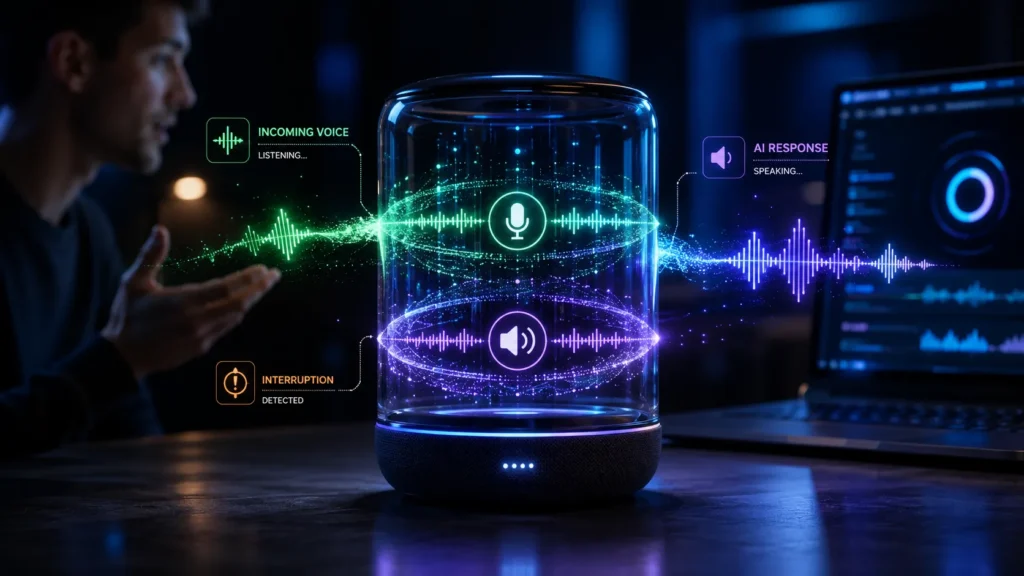
References to the model have reportedly appeared inside ChatGPT’s web and mobile interfaces, suggesting that OpenAI may be preparing a major upgrade for Voice Mode. The model is said to support bidirectional audio, allowing ChatGPT to listen while it is still speaking.
OpenAI has not officially announced GPT-Bidi-1, its release date or where it will be available.
What Is GPT-Bidi-1?
The name “Bidi” appears to refer to bidirectional communication.
In a normal voice interaction, one side speaks while the other waits. A bidirectional model can process incoming audio and generate spoken responses at the same time.
In practical terms, this could allow users to interrupt ChatGPT naturally without forcing the conversation to restart.
For example, a user could ask ChatGPT to count from one to ten and then interrupt midway with a new instruction. Instead of ignoring the change or finishing the original response, the model could adjust immediately.
Early testing also suggests that the model may give short acknowledgements, such as “okay,” while the user is still talking. These small reactions could make conversations feel more responsive.
ChatGPT Could Handle Interruptions More Naturally
Current AI voice assistants often struggle when users pause, speak over them or change their request midway through a sentence.
GPT-Bidi-1 is reportedly designed to continue listening even while producing audio. This may help it understand whether the user is correcting an answer, adding more information or moving to a different task.
The model could also reduce awkward pauses. Instead of treating every silence as the end of a sentence, it may wait longer and recognise when the user is still thinking.
This would be useful during longer conversations where users do not always speak in complete, carefully structured sentences.
Longer Conversations May Keep More Context
Another reported improvement is stronger context retention.
Voice Mode can sometimes lose track of details shared earlier in a long conversation. A newer audio system could help ChatGPT remember previous instructions, names and changes without repeatedly asking the user to explain them again.
That could make Voice Mode more useful for:
- Planning a trip
- Practising a language
- Following cooking instructions
- Studying a difficult topic
- Managing tasks while driving
- Holding longer brainstorming sessions
However, independent testing will be needed to confirm how well the model performs across different accents, languages and noisy environments.
Real-Time Translation Could Be a Major Use Case
Reports also suggest that bidirectional voice technology could support real-time translation.
Instead of waiting for one speaker to finish, ChatGPT could potentially listen to a live conversation and translate it as people speak.
This could make the technology useful for travel, customer support, online meetings and conversations between people who speak different languages.
OpenAI has already been investing heavily in real-time audio and translation models. A ChatGPT-focused bidirectional system would be a natural next step, but the company has not confirmed whether GPT-Bidi-1 will include translation at launch.
Could GPT-Bidi-1 Also Come to Codex?
Some leaked references suggest that the voice technology could eventually be connected to Codex.
Voice support in Codex could allow developers to describe changes, ask questions about code or correct an AI agent without stopping their work to type.
This could be particularly useful during debugging or while reviewing a project. However, there is no confirmed timeline for a Codex integration.
What Has OpenAI Confirmed?
OpenAI has officially introduced newer real-time voice models that can reason, use tools, handle corrections and continue conversations more naturally.
However, the company has not publicly confirmed:
- The GPT-Bidi-1 name
- A ChatGPT rollout date
- Supported subscription plans
- Regional availability
- API access
- Pricing
- Codex integration
The model name may also be an internal label that changes before launch.
A More Human Voice Mode May Be Coming
The biggest improvement may not be a new voice or faster answers. It may simply be ChatGPT’s ability to participate in a conversation without forcing users to follow a rigid turn-by-turn format.
Being able to interrupt, correct or redirect an AI assistant while it speaks would make Voice Mode feel more natural and useful.
For now, GPT-Bidi-1 remains an unconfirmed model spotted through leaked references and early testing. If OpenAI releases it widely, it could become one of the most important changes to ChatGPT Voice Mode so far.