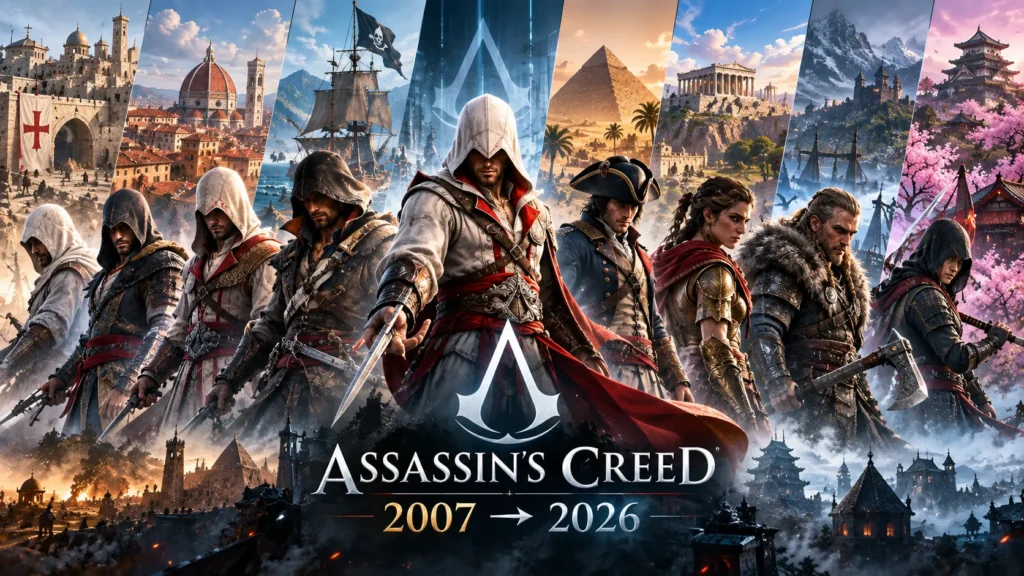
The Assassin’s Creed game series began in 2007 and has grown into one of Ubisoft’s biggest historical action-adventure franchises. The main series currently runs from the original Assassin’s Creed to Assassin’s Creed Shadows, while 2026 also brought Assassin’s Creed Black Flag Resynced, an enhanced remake of the 2013 pirate adventure.
If you are confused about which Assassin’s Creed game comes first, which one you should play, or how the historical timeline works, this guide puts the series in a simple order.
Quick answer: New players should generally play the Assassin’s Creed games in release order. This keeps the modern-day story, gameplay evolution and major character reveals in the order Ubisoft originally presented them.
Assassin’s Creed Games in Release Order
The following list covers the major PC and console entries in the Assassin’s Creed series.
| # | Game | Release Year | Main Historical Setting |
|---|---|---|---|
| 1 | Assassin’s Creed | 2007 | Third Crusade |
| 2 | Assassin’s Creed II | 2009 | Italian Renaissance |
| 3 | Assassin’s Creed: Brotherhood | 2010 | Renaissance Rome |
| 4 | Assassin’s Creed: Revelations | 2011 | Ottoman Constantinople |
| 5 | Assassin’s Creed III | 2012 | American Revolution |
| 6 | Assassin’s Creed IV: Black Flag | 2013 | Golden Age of Piracy |
| 7 | Assassin’s Creed Rogue | 2014 | Seven Years’ War |
| 8 | Assassin’s Creed Unity | 2014 | French Revolution |
| 9 | Assassin’s Creed Syndicate | 2015 | Victorian London |
| 10 | Assassin’s Creed Origins | 2017 | Ptolemaic Egypt |
| 11 | Assassin’s Creed Odyssey | 2018 | Ancient Greece |
| 12 | Assassin’s Creed Valhalla | 2020 | Viking Age England |
| 13 | Assassin’s Creed Mirage | 2023 | 9th-century Baghdad |
| 14 | Assassin’s Creed Shadows | 2025 | Feudal Japan |
Ubisoft’s own series guide follows broadly the same release-order approach, starting with the 2007 game and moving through the franchise as its gameplay and overarching story evolved.
1. Assassin’s Creed (2007)
The original Assassin’s Creed introduced the core ideas that would define the franchise: stealth assassinations, parkour, historical cities and the conflict between the Assassins and Templars.
Players control Altaïr Ibn-La’Ahad during the Third Crusade in 1191 while modern-day protagonist Desmond Miles uses the Animus to experience Altaïr’s genetic memories.
The first game is more repetitive than later entries, but it establishes many of the concepts that become important throughout the series.
2. Assassin’s Creed II (2009)
Assassin’s Creed II introduces Ezio Auditore da Firenze, who would become one of the franchise’s most recognizable protagonists.
Set during the Italian Renaissance, the game expands almost every major system from the original, including combat, exploration, weapons and mission variety.
It also begins what fans commonly call the Ezio Trilogy.
3. Assassin’s Creed: Brotherhood (2010)
Brotherhood continues Ezio’s story as he travels to Rome to fight the Borgia-controlled Templars.
One of its major additions is the ability to recruit Assassins and call them into battle. Players can also rebuild parts of Rome by purchasing and restoring businesses.
4. Assassin’s Creed: Revelations (2011)
Revelations concludes Ezio’s main story while also reconnecting the series with Altaïr.
The adventure takes place primarily in Constantinople and introduces tools such as the hookblade while bringing several long-running story threads together.
Players interested in Ezio should play Assassin’s Creed II, Brotherhood and Revelations in that order.
5. Assassin’s Creed III (2012)
Assassin’s Creed III moves the historical story to the American Revolution.
The main Assassin is Ratonhnhaké:ton, better known as Connor. The game features Boston, New York and large wilderness areas while introducing early versions of naval gameplay that would become much more important in Black Flag.
It also concludes the major Desmond Miles modern-day storyline that began with the first game.
6. Assassin’s Creed IV: Black Flag (2013)
Black Flag is set during the Golden Age of Piracy and stars Edward Kenway, Connor’s grandfather.
Instead of keeping naval combat as a secondary feature, Black Flag makes sailing, ship battles and Caribbean exploration major parts of the game.
Players command Edward’s ship, the Jackdaw, while exploring islands, settlements, underwater locations and open sea.
The popularity of its pirate setting eventually led Ubisoft to revisit the title with Assassin’s Creed Black Flag Resynced in 2026.
7. Assassin’s Creed Rogue (2014)
Assassin’s Creed Rogue offers an unusual perspective by placing players in the role of Shay Cormac, a former Assassin who joins the Templar Order.
The game is set during the Seven Years’ War and uses several systems developed for Black Flag, including naval exploration.
Rogue is especially useful before playing Unity because the stories contain an important direct connection.
8. Assassin’s Creed Unity (2014)
Assassin’s Creed Unity takes place during the French Revolution and follows Arno Dorian in Paris.
The game introduced redesigned parkour, larger crowds, more detailed environments and cooperative missions.
Its launch became known for technical problems, although later updates addressed many issues.
9. Assassin’s Creed Syndicate (2015)
Assassin’s Creed Syndicate moves the series to Victorian London during the Industrial Revolution.
Players switch between twin Assassins Jacob and Evie Frye. Jacob focuses more heavily on direct combat, while Evie is particularly suited to traditional stealth.
Carriages, trains and a rope launcher help players move through the much wider streets of London.
10. Assassin’s Creed Origins (2017)
Assassin’s Creed Origins marked one of the biggest gameplay changes in the franchise.
Set in Ptolemaic Egypt, it follows Bayek of Siwa and explores the origins of the Hidden Ones, the organization that eventually develops into the Assassin Brotherhood.
Origins introduced stronger action-RPG elements, including character levels, loot, quests and a redesigned combat system.
11. Assassin’s Creed Odyssey (2018)
Assassin’s Creed Odyssey takes the historical timeline even further back to Ancient Greece during the Peloponnesian War.
Players choose between Kassandra and Alexios and explore a huge version of the Greek world.
Odyssey pushes the RPG approach further with dialogue choices, romances, branching decisions, abilities and extensive gear systems.
If large historical worlds are what attract you to Assassin’s Creed, you may also like our guide to the top open-world games.
12. Assassin’s Creed Valhalla (2020)
Assassin’s Creed Valhalla follows Viking warrior Eivor as their clan travels from Norway to England in search of a new home.
Its enormous world combines raids, settlement building, exploration and RPG combat with the wider Assassin–Templar storyline.
Valhalla is also important because it introduces Basim, who later becomes the protagonist of Assassin’s Creed Mirage.
13. Assassin’s Creed Mirage (2023)
Assassin’s Creed Mirage takes place in ninth-century Baghdad and tells the earlier story of Basim Ibn Ishaq.
Compared with the huge RPG worlds of Odyssey and Valhalla, Mirage is smaller and places greater emphasis on stealth, assassinations, investigation and parkour.
Ubisoft described it as an experience designed to bring several elements of Assassin’s Creed back toward the franchise’s roots.
14. Assassin’s Creed Shadows (2025)
Assassin’s Creed Shadows finally brought the main series to feudal Japan.
The game features two protagonists with different playstyles: Naoe, a shinobi who specializes in stealth, and Yasuke, a samurai designed around more direct combat.
Ubisoft released Assassin’s Creed Shadows on March 20, 2025.
As of October 2026, Shadows remains the latest original mainline Assassin’s Creed game.
What Is Assassin’s Creed Black Flag Resynced?
Assassin’s Creed Black Flag Resynced was released on July 9, 2026.
However, it should not be confused with Assassin’s Creed 15 or a completely new chapter in the historical storyline.
Black Flag Resynced is an enhanced remake of Assassin’s Creed IV: Black Flag. Ubisoft rebuilt the pirate adventure using a newer version of the Anvil engine while adding improved visuals, gameplay changes and new content.
It is available on PC, PlayStation 5 and Xbox Series X|S.
Assassin’s Creed Games in Chronological Order
If you want to arrange the games according to their main historical settings rather than their release dates, the order changes significantly.
| Historical Order | Game | Approximate Era |
|---|---|---|
| 1 | Assassin’s Creed Odyssey | Ancient Greece, 5th century BCE |
| 2 | Assassin’s Creed Origins | Ancient Egypt, 1st century BCE |
| 3 | Assassin’s Creed Mirage | Baghdad, 9th century |
| 4 | Assassin’s Creed Valhalla | Viking Age, 9th century |
| 5 | Assassin’s Creed | 1191 |
| 6 | Assassin’s Creed II | Italian Renaissance |
| 7 | Assassin’s Creed: Brotherhood | Early 16th century |
| 8 | Assassin’s Creed: Revelations | 1511–1512 |
| 9 | Assassin’s Creed Shadows | Late Sengoku-period Japan |
| 10 | Assassin’s Creed IV: Black Flag | Golden Age of Piracy |
| 11 | Assassin’s Creed Rogue | Seven Years’ War |
| 12 | Assassin’s Creed III | American Revolution |
| 13 | Assassin’s Creed Unity | French Revolution |
| 14 | Assassin’s Creed Syndicate | Victorian London |
This order works if you mainly care about the historical periods, but it is not the best order for following the complete story. Assassin’s Creed also contains a modern-day narrative that was written around the games’ release order.
Should You Play Assassin’s Creed in Release or Chronological Order?
First-time players should choose release order.
Starting with the older games lets you understand how the Animus, Assassins, Templars, Pieces of Eden and modern-day characters are introduced.
You also experience the gameplay naturally evolving from classic stealth and parkour to naval exploration and eventually full action-RPG systems.
Chronological order is better suited to returning players who already understand the wider Assassin’s Creed story and mainly want to experience the historical settings in sequence.
Which Assassin’s Creed Game Should You Start With?
There is no single starting point that fits every type of player.
| If You Want… | Start With |
|---|---|
| The complete story from the beginning | Assassin’s Creed (2007) |
| The classic Assassin’s Creed experience | Assassin’s Creed II |
| Pirates and naval exploration | Assassin’s Creed IV: Black Flag or Black Flag Resynced |
| A modern RPG | Assassin’s Creed Origins |
| A smaller stealth-focused modern game | Assassin’s Creed Mirage |
| Feudal Japan | Assassin’s Creed Shadows |
If you plan to play several entries and care about the overarching story, starting with the original game or Assassin’s Creed II makes the most sense.
What Are the Assassin’s Creed Spin-Off Games?
Besides the major PC and console releases, Ubisoft has released a number of smaller Assassin’s Creed games and side stories.
Some of the best-known include:
- Assassin’s Creed: Altaïr’s Chronicles
- Assassin’s Creed: Bloodlines
- Assassin’s Creed II: Discovery
- Assassin’s Creed III: Liberation
- Assassin’s Creed Freedom Cry
- Assassin’s Creed Chronicles: China
- Assassin’s Creed Chronicles: India
- Assassin’s Creed Chronicles: Russia
The Chronicles trilogy is particularly different from the main games, using a 2.5D action-stealth format instead of the large 3D open worlds associated with most Assassin’s Creed titles.
You do not need to play every spin-off to understand the main series.
How Has the Assassin’s Creed Series Changed?
The Assassin’s Creed game series can roughly be divided into different gameplay eras.
Classic Assassin Era
The early games focus heavily on stealth, social blending, parkour and targeted assassinations. This includes games such as Assassin’s Creed, the Ezio trilogy and Assassin’s Creed III.
Open-World and Naval Era
Black Flag and Rogue dramatically expanded naval exploration, while Unity and Syndicate focused on large, detailed cities and more advanced traversal systems.
RPG Era
Origins redesigned the franchise around action-RPG mechanics. Odyssey and Valhalla expanded that approach with larger worlds, loot, abilities and more player choice.
Modern Mixed Approach
Ubisoft no longer appears to be using one single formula for every Assassin’s Creed game. Mirage returned to a smaller stealth-focused design, while Shadows continued the large open-world direction with two distinct protagonists. If you enjoy modern open-world action RPGs with a strong focus on story and player choice, you can also explore our guide to The Blood of Dawnwalker.
What Is the Latest Assassin’s Creed Game?
There are two useful answers depending on what you mean by “latest.”
Latest Assassin’s Creed release: Assassin’s Creed Black Flag Resynced, released July 9, 2026.
Latest original mainline game: Assassin’s Creed Shadows, released March 20, 2025.
This distinction matters because Black Flag Resynced revisits Edward Kenway’s existing story rather than introducing an entirely new mainline historical chapter.
What Is Next for Assassin’s Creed?
Ubisoft confirmed in its March 2026 franchise update that several Assassin’s Creed projects remain in development.
Codename Hexe is being developed by Ubisoft Montreal and is described by Ubisoft as a darker, more narrative-driven Assassin’s Creed experience.
Codename Invictus is a standalone PvP multiplayer Assassin’s Creed project being developed with a team that includes For Honor veterans.
Assassin’s Creed Jade, a mobile Assassin’s Creed project set in ancient China, also remained in development as of Ubisoft’s 2026 update.
Ubisoft had not provided firm release dates for these projects in that update, so rumored launch dates should not be treated as confirmed.
Assassin’s Creed Game Series: Quick Summary
For someone entering the franchise today, the easiest way to understand the Assassin’s Creed series is:
- Start with the games in release order if story continuity matters.
- Start with Assassin’s Creed II if you want a strong example of the classic formula.
- Try Black Flag if pirates and naval exploration appeal to you.
- Start with Origins for the modern RPG-style games.
- Choose Mirage for a more compact stealth-focused experience.
- Choose Shadows if you want the newest original mainline Assassin’s Creed adventure.
The franchise has changed significantly since 2007, but its central idea remains recognizable: exploring different periods of human history through the conflict between Assassins, Templars and the civilizations that came before them.
Frequently Asked Questions
How many main Assassin’s Creed games are there?
There are 14 major original PC and console entries from Assassin’s Creed (2007) through Assassin’s Creed Shadows (2025). The franchise also contains remakes, spin-offs, mobile games and standalone side stories.
What is the first Assassin’s Creed game?
The first game is Assassin’s Creed, released in 2007. It follows Altaïr during the Third Crusade and introduces Desmond Miles, the Animus and the Assassin–Templar conflict.
What is the latest Assassin’s Creed game in 2026?
The latest released Assassin’s Creed title is Assassin’s Creed Black Flag Resynced, released on July 9, 2026. However, it is a remake. Assassin’s Creed Shadows remains the latest original mainline entry.
What order should I play Assassin’s Creed games in?
For a first playthrough, release order is recommended because the modern-day storyline and major reveals were designed around that sequence. Historical chronological order is better for returning players.
Do I need to play every Assassin’s Creed game?
No. Many Assassin’s Creed games have self-contained historical stories. However, playing the older main entries in release order makes the recurring modern-day story, Assassin–Templar conflict and character connections easier to understand.