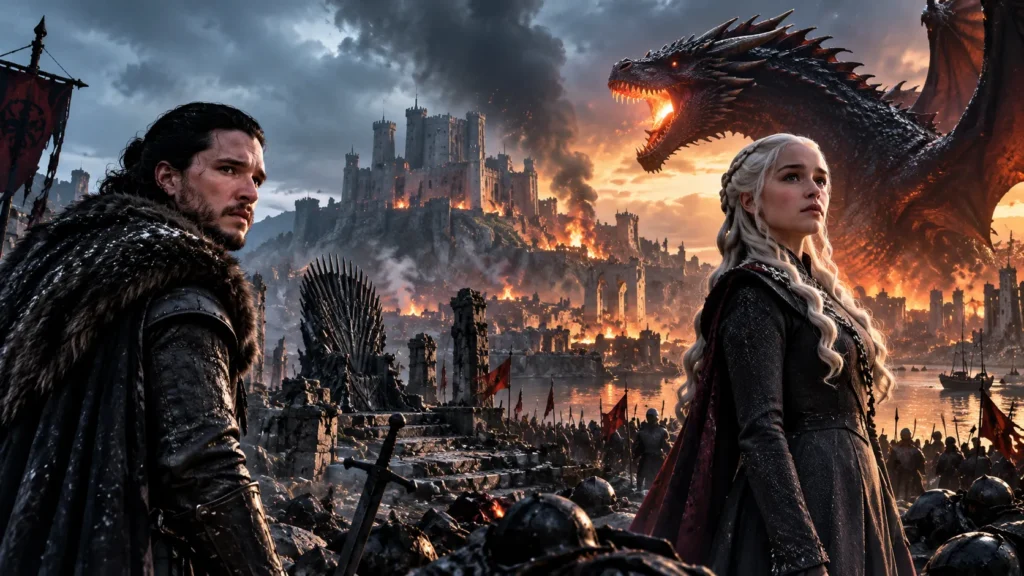
Game of Thrones Season 8 is the eighth and final season of HBO’s fantasy series. It premiered on April 14, 2019, and ended on May 19, 2019, with just six episodes. The final season concludes the wars against the Night King and Cersei Lannister before revealing who ultimately rules Westeros.
The GOT 8th season delivered some of the show’s biggest battles and most important character endings, but its faster pacing and several major story decisions also made it the most divisive season of the series.
Spoiler warning: This article explains the complete Game of Thrones Season 8 story and ending.
Game of Thrones Season 8 at a Glance
| Detail | Game of Thrones Season 8 |
|---|---|
| Season | 8 |
| First Episode | April 14, 2019 |
| Final Episode | May 19, 2019 |
| Total Episodes | 6 |
| Network | HBO |
| Final Episode | The Iron Throne |
| Final Ruler of the Six Kingdoms | Bran Stark |
| Queen in the North | Sansa Stark |
Game of Thrones Season 8 Episode List
Unlike the first six seasons, which each had ten episodes, the final season contained only six. Several episodes were longer than a standard television episode to accommodate the major battles and the conclusion of multiple storylines.
| Episode | Title | Original Air Date |
|---|---|---|
| 1 | Winterfell | April 14, 2019 |
| 2 | A Knight of the Seven Kingdoms | April 21, 2019 |
| 3 | The Long Night | April 28, 2019 |
| 4 | The Last of the Starks | May 5, 2019 |
| 5 | The Bells | May 12, 2019 |
| 6 | The Iron Throne | May 19, 2019 |
What Happens in Game of Thrones Season 8?
Episode 1: Winterfell
Jon Snow and Daenerys Targaryen arrive at Winterfell with her armies and dragons as the living prepare for the approaching Army of the Dead.
Jon reunites with Arya and Bran, while tensions grow between Daenerys and Sansa. Samwell Tarly then tells Jon the truth about his identity: he is Aegon Targaryen, the son of Rhaegar Targaryen and Lyanna Stark, giving him a stronger claim to the Iron Throne than Daenerys.
Meanwhile, Theon rescues Yara from Euron Greyjoy before returning north to help defend Winterfell.
Episode 2: A Knight of the Seven Kingdoms
The second episode slows the story down before the battle and allows many characters to spend what could be their final night together.
One of its biggest moments comes when Jaime Lannister knights Brienne of Tarth, finally giving her the recognition she had long deserved.
Jon also reveals his true Targaryen identity to Daenerys, creating another conflict between them just before the Army of the Dead reaches Winterfell.
Episode 3: The Long Night
The Battle of Winterfell becomes the main focus of the third episode as the Night King and his Army of the Dead attack.
Several characters die during the battle, including Theon Greyjoy, Jorah Mormont, Lyanna Mormont and Beric Dondarrion.
The biggest surprise comes near the end when Arya Stark kills the Night King using the Valyrian steel dagger. His death destroys the White Walkers and their undead army, ending the supernatural threat that had been developing since the beginning of the series.
Episode 4: The Last of the Starks
After surviving the Night King, Daenerys turns her attention toward Cersei and King’s Landing.
Jon tells Arya and Sansa about his true parentage despite Daenerys asking him to keep it secret. The information quickly spreads through Tyrion and Varys, increasing doubts about Daenerys’ claim to the throne.
On the journey south, Euron Greyjoy’s forces kill Daenerys’ dragon Rhaegal and capture Missandei.
Cersei later orders Missandei’s execution in front of Daenerys, Grey Worm and Tyrion.
Episode 5: The Bells
Daenerys attacks King’s Landing with Drogon and quickly destroys the city’s defenses.
The bells ring to signal surrender, but Daenerys continues the attack and burns large parts of King’s Landing, killing soldiers and civilians.
Elsewhere, Sandor Clegane finally confronts his brother Gregor in the long-awaited “Cleganebowl.” Both brothers die during their fight.
Jaime reunites with Cersei beneath the Red Keep, but the pair are killed when the structure collapses around them.
Episode 6: The Iron Throne
The series finale begins in the ruins of King’s Landing.
Daenerys declares victory and makes it clear that she intends to continue her campaign beyond the capital. Tyrion rejects her rule and removes his Hand of the Queen pin, leading to his arrest.
Tyrion later convinces Jon that Daenerys could continue killing anyone she considers an enemy.
Jon meets Daenerys in the throne room and kills her while embracing her.
Drogon discovers Daenerys’ body but does not attack Jon. Instead, he melts the Iron Throne with dragonfire before flying away with Daenerys.
Game of Thrones Season 8 Ending Explained
The ending separates the surviving major characters rather than placing one traditional winner on the Iron Throne.
Why Did Jon Snow Kill Daenerys?
Jon kills Daenerys after seeing what happened to King’s Landing and realizing that her idea of liberation could lead to more destruction.
Daenerys believes she knows what is right for the world and intends to continue changing Westeros and other lands through her own vision of justice.
Jon still loves her, but after speaking with Tyrion, he decides that allowing her to continue ruling could put his sisters and many others in danger.
Why Did Drogon Destroy the Iron Throne?
After finding Daenerys dead, Drogon melts the Iron Throne instead of killing Jon.
The show does not explicitly explain Drogon’s reasoning. Symbolically, however, destroying the throne ends the object that represented the struggle for power throughout the series.
Drogon then carries Daenerys’ body away and disappears.
Who Becomes King at the End of Game of Thrones?
Bran Stark becomes King of the Six Kingdoms.
After Daenerys’ death, representatives of Westeros gather to decide what happens next. Tyrion argues that future rulers should be selected rather than automatically inheriting the crown.
The council chooses Bran, who accepts the position and names Tyrion as his Hand.
However, Sansa refuses to bring the North back under southern rule.
What Happens to Sansa Stark?
The North becomes an independent kingdom, separate from Bran’s Six Kingdoms.
Sansa returns to Winterfell and is crowned Queen in the North, completing her journey from a young noblewoman who wanted to leave Winterfell to the ruler of an independent North.
What Happens to Arya Stark?
Arya decides she does not want to remain in Westeros.
Instead, she sails west of Westeros to explore lands that are not shown on existing maps.
What Happens to Jon Snow?
Jon is sent back to the Night’s Watch as part of a compromise following Daenerys’ death.
In the final scenes, Jon travels beyond the Wall with Tormund, Ghost and the Free Folk.
The ending leaves some interpretation about whether Jon remains part of the Night’s Watch or begins a new life in the far North, but his final scene shows him moving away from the politics of Westeros.
What Happens to Tyrion Lannister?
Tyrion survives and becomes Hand of the King to Bran.
Rather than receiving complete freedom, he is expected to spend the coming years helping repair the damage caused by previous rulers and his own decisions.
Why Was Game of Thrones Season 8 So Controversial?
The final season was not disliked simply because particular characters died. Game of Thrones had always killed major characters unexpectedly.
The larger criticism was the speed at which major character and story changes happened.
Earlier seasons sometimes spent several episodes developing political decisions and character motivations. Season 8 had only six episodes to resolve the Night King, Jon’s true identity, Cersei’s reign, Daenerys’ campaign, the Iron Throne and the futures of nearly every surviving major character.
This made several important developments feel compressed.
Daenerys’ Final Character Arc
Daenerys had shown ruthless behaviour before Season 8, but her transition from a ruler trying to protect ordinary people to destroying King’s Landing became one of the season’s most debated choices.
The idea itself fits themes that had existed throughout her story, including her willingness to use extreme violence against people she considered enemies.
The problem for many viewers was how quickly the final change happened. More episodes showing her isolation, grief and increasing distrust could have made the transition feel more developed.
The Night King Was Defeated Very Early
The White Walkers had been presented as the ultimate threat since the opening episode of Game of Thrones.
Season 8 resolves that conflict in Episode 3 when Arya kills the Night King.
The moment is surprising and visually dramatic, but it also means that the supernatural conflict ends before the final battle for King’s Landing.
Jon Snow’s Identity Had Limited Impact
Season 7 reveals that Jon is actually Aegon Targaryen, and Season 8 confirms the information to him.
The revelation creates tension between Jon and Daenerys and helps weaken Daenerys’ political position, but Jon never seriously attempts to claim the throne himself.
As a result, one of the biggest revelations in the entire series has less direct impact on the final political outcome than many viewers expected.
Bran Becoming King Needed More Development
Bran’s selection as king is consistent with the finale’s attempt to move Westeros away from hereditary monarchy, but the series spends relatively little time establishing Bran as a potential ruler before the final episode.
That makes the decision understandable within the council scene while still feeling sudden compared with characters whose political ambitions had been central for multiple seasons.
Game of Thrones Season 8 Review
Game of Thrones Season 8 is at its strongest when it focuses on visual spectacle, performances, music and character interactions.
The Battle of Winterfell and destruction of King’s Landing remain enormous television productions. Ramin Djawadi’s music continues to elevate major scenes, while the cast delivers strong performances even when the story moves rapidly.
A Knight of the Seven Kingdoms is particularly effective because it gives the characters room to talk, remember their journeys and prepare for what they believe could be their final night alive. Brienne’s knighting scene is one of the season’s strongest emotional moments.
The main weakness is pacing.
Six episodes simply leave limited space to conclude so many major storylines. Daenerys’ transformation, the end of the White Walker conflict, Jaime’s return to Cersei and Bran’s eventual selection as king all could have benefited from more development.
The season therefore feels less like the carefully layered political drama of earlier Game of Thrones and more like a rapid sequence of major conclusions.
If you enjoy story-heavy medieval fantasy worlds, you can also check out our guide to The Blood of Dawnwalker, a dark fantasy RPG focused on player choices and story.
That does not make everything in Season 8 unsuccessful. The production quality is exceptional, several performances are excellent and some individual scenes provide strong emotional payoffs.
But as the conclusion to a story built across eight seasons, its biggest problem is that many important ideas arrive faster than the story can fully develop them.
Was Game of Thrones Season 8 the Final Season?
Yes. Season 8 was the final season of Game of Thrones, ending the main television series after 73 total episodes.
The world of Westeros continued through separate television projects, but the story of Jon Snow, Daenerys Targaryen, Tyrion Lannister, Arya Stark, Sansa Stark and the battle for the Iron Throne concludes in Season 8.
For more television-series coverage, read our latest update on Fallout Season 3 and what its next chapter could explore.
Frequently Asked Questions
Game of Thrones Season 8 has 6 episodes. It is the shortest season of the series and aired from April 14 to May 19, 2019.
Bran Stark becomes King of the Six Kingdoms after the council chooses him as ruler. The North becomes independent under Sansa Stark.
Jon Snow kills Daenerys because he believes her rule could lead to more destruction after she burns King’s Landing and plans to continue her campaign across Westeros.
Arya Stark kills the Night King in Episode 3, “The Long Night,” using a Valyrian steel dagger during the Battle of Winterfell.
Season 8 was controversial mainly because of its fast pacing and the limited development of major storylines, including Daenerys’ final arc, the Night King’s defeat and Bran becoming king.